
Beyond Human Precision
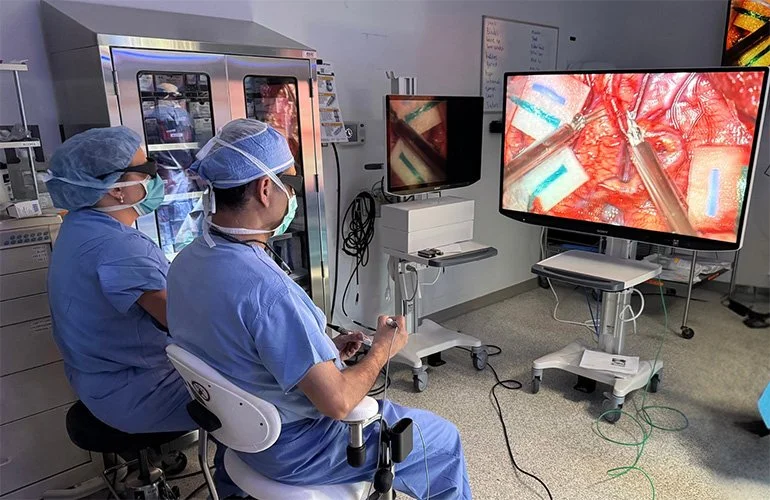
“When you think about surgery that’s small, the limitations of the human body are pretty real,” says Mark Toland, CEO of Medical Microinstruments.
Microsurgery, that is, operations on structures so small that the procedure must be performed under a microscope, requires the steadiest touch. Tremors and accidental movements can have grave consequences. This is one field that seems tailor made for surgical robots.
MMI’s Symani Surgical System, which received FDA de novo classification in 2024, addresses the need for precision and control. The Symani platform helps surgeons to reconnect and repair tiny structures like lymphatic vessels and blood vessels that can be less than one millimetre in diameter. The Symani system was the first robotic surgical platform available in the United States for reconstructive microsurgery. Last December, the system received additional clearance for use in soft tissue surgery.
Says Toland, “the robot comes in and what we call ‘democratizes’ vessel size.”
According to MMI, their miniaturized instruments are the world’s smallest. The surgeon uses handheld controllers, which allow the surgeon to work from the patient’s bedside or another location. Symani’s system filters out tremors. Intentional hand and wrist motions are translated into scaled down robotic movements. The surgeon can set the motion scaling factor from 7x to 20x.
Bodhan Pomahac, a surgeon who leads Symani’s PRECISE post-market trial, says that the system’s motion scaling feature is different from that of other soft tissue surgical platforms coming to market, such as Intuitive’s da Vinci robot. The PRECISE study will follow up to 455 patients to evaluate the robot’s performance in reconstructive and lymphatic repair procedures.
Says Pomahac, “What’s very unique about this technology is the scaling. The advantage of the system and technology is that it’s intended to be a high precision tool.” That level of control enables surgeons to perform procedures that otherwise might not be feasible, Pomahac also said. Pomahac is also Chief of Plastic and Reconstructive Surgery and Director of the Face Transplant Program at Yale Medicine.
One primary focus for MMI’s robotic surgery platform is the treatment of lymphedema, the abnormal buildup of lymphatic fluid in the body. Lymphedema is one possible side effect of cancer and cancer treatments, both of which can block or damage the lymph nodes. Lymphedema can result in swelling, discomfort, and infection. Dr. Robert Van has successfully used Symani to perform a lymphovenous bypass in order to treat lymphedema. In clinical studies the Symani system provided an 86% reduction in upper limb volume with this procedure. The system also demonstrated 100% patency on first attempt in 0.2 millimeter vessels, compared to 80% patency when done by hand.
And that’s only the beginning. Says Toland,
“We’re doing breast reconstruction. We’re doing lymphatic repair across the body. We’re doing transplants for patients who have suffered from extremity trauma, typically from manufacturing accidents. We’ve even done wounded warriors who are coming back from battle. So it’s a pretty rewarding technology, because it’s enabling physicians to reconstruct the body in a way that they may not have been able to do with their human hands before.”
Every year, forty million open surgical procedures are performed in the United States. That’s four times the number of laparoscopic procedures that are performed, according to Toland. And that promises a vast market for robotic surgery instruments.
Intuitive’s da Vinci platform is used primarily for procedures in the abdomen and pelvis, for example operations involving the prostate, uterus, colon, and gallbladder. The Symani system, says Toland, can be used for microsurgery throughout the body.
“Laparoscopic stuff is in the belly,” says Toland. “We’re kind of doing all the other stuff, which is a great situation to be in, because you’re really not ever competing against the 800-pound gorilla, being Intuitive.”
Microsurgery, on the other hand, is largely concerned with putting the body back together. Recently, MMI has expanded its area of interest into reconstructive head and neck procedures for cancer patients. Symani has also recently been cleared for use in scalp and mouth procedures. The platform has furthermore supported cochlear implants, ophthalmic procedures, intracranial brain surgery, liver transplantation, and spine tumor removal.
So far, surgeons have used the Symani platform in some 3,000 procedures.
Says Toland, “We’re trying to move the line of complexity for all physicians who want to do microsurgery, or supermicrosurgery.”
Where will the Symani system be used next?
Currently, the platform is being used in a study called REMIND, which is supporting MMI’s application for Investigational Device Exemption for Symani. The study is evaluating the use of the platform in the treatment of neurodegenerative diseases, such as Alzheimer's. The trial is investigating whether restoring lymphatic drainage pathways deep in cervical lymph nodes can help to clear the neurotoxins that researchers believe contribute to the progression of these diseases.
The study has just treated its first Alzheimer’s patient.The patient has moderate Alzheimer’s disease with confirmed abnormalities in their deep cervical lymph node region.
“This isn’t just surgery,” said Toland. “This is pushing the boundaries of medicine.”
MMI is enrolling patients in six clinical trials this year.
Right now, the Symani system is the only commercially available FDA approved robotic microsurgery system. However, another company, Microsure, has just received the CE mark in Europe for its MUSA-3 system. Medtronic, Johnson & Johnson, Shanghai–based MicroPort MedBot and a Japanese company, Medicaroid, are also stepping into the robotic surgery ring. In addition to the expansion of procedures for soft tissues, we can expect developments in cardiac surgery and other specialized procedures that require high precision and steady control.
At this point, cost and limitations in infrastructure limit the use of robotic surgery platforms to large hospitals and academic medical centers. However, some companies, such as Swiss company Distalmotion, are bringing the technology to ambulatory surgery centers (ASCs). ASCs typically operate at a lower cost, perform a variety of outpatient procedures. Often, surgeons have an ownership stake.
“We solve a lot of those problems,” says Distalmotion CEO Greg Roche. “We believe that the cost profile of our robot allows for profitability within these lower-acuity, high-volume surgeries.”